
In Jiu-Jitsu, Feel Is the Real Product
Technique is not the ultimate product. Feel is. Understanding that difference may change how you think about coaching, class structure, and gym culture.
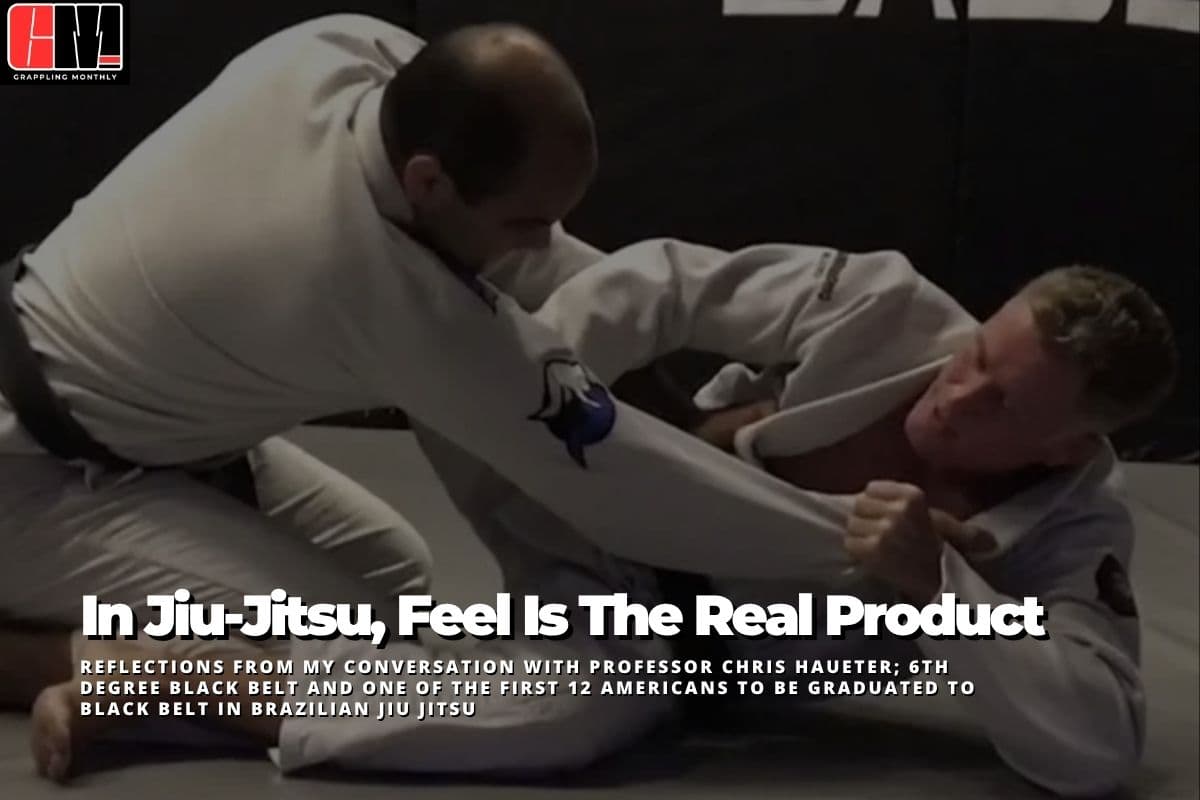
Reflections from my conversation with Professor Chris Haueter, 6th degree black belt and one of the first 12 Americans to receive a black belt in Brazilian Jiu-Jitsu.
Brazilian jiu-jitsu is often described as a technical art. Instructional videos, competition highlights, and social media clips reinforce the idea that progress comes from accumulating techniques.
But when you spend enough time on the mat, a different reality becomes obvious.
Technique is not the ultimate product. Feel is.
What most academies actually sell, whether they realize it or not, is a structured environment where people can develop timing, pressure, balance, and decision-making through repeated physical interaction with other human beings.
In other words, they sell a learning experience that cannot be downloaded. Understanding that difference may change how you think about coaching, class structure, and gym culture.
Watching and Learning Isn't Enough
Today's grapplers have access to more technical information than any generation before them. Thousands of hours of instructionals, match footage from every major tournament, clips of elite athletes explaining positions in under sixty seconds. None of that replaces the actual process of learning.
Watching jiu-jitsu creates familiarity. It does not create ability.
You can watch an armbar ten thousand times and still fail to finish it against a resisting opponent. The missing ingredient is a little less about information and a little more about tactical awareness and understanding through practice.
If you've trained jiu-jitsu, you've likely had some version of the following experience: your coach adjusts your grip by an inch. Your hips shift slightly. Your weight settles differently. Suddenly the position works in a way it didn't before.
This is because jiu-jitsu is an art of pressure, balance, timing, and weight distribution. Those things exist below the level of sight. They are felt before they are understood.
Feel as a Product Decision
If feel is the real product, then the structure of training becomes the most important design choice a gym makes. A school that claims to sell technique but structures training poorly is not delivering the thing students actually need.
Feel develops through three ingredients: repetition, resistance, and variation. And those ingredients are controlled through the decisions coaches make about how classes run. Partner selection matters. Round structure matters. Constraints matter.
If beginners only drill compliant techniques, they never learn how pressure changes positions. If advanced students roll freely every round, they often reinforce habits rather than refine mechanics.
The design of training determines whether students develop awareness or simply collect moves. Good coaches understand this intuitively. They organize classes so students experience a position repeatedly from slightly different angles.
The goal is not to show more techniques. The goal is to create more moments where the body learns what correct pressure feels like.
The Mat as Scientific Method
One of the most valuable aspects of jiu-jitsu is that it functions as a laboratory.
Ideas are constantly tested. A technique either works or it does not. A position either holds or it collapses. This creates an environment where feedback is immediate and unavoidable. But that feedback only functions if ego is kept under control.
When people roll only to win rounds, they avoid the situations where learning happens. They hide weaknesses instead of exposing them. The scientific method requires the opposite mindset. Instead of proving yourself right, try to discover where you are wrong.
The mat rewards this approach. When someone is willing to put themselves in difficult positions repeatedly, their understanding deepens quickly. Over time, the goal shifts. Instead of trying to dominate rounds, the objective becomes improving the quality of movement and decision-making within them.
The best gyms build a culture where experimentation is normal. Students are encouraged to test ideas rather than defend reputations. That shift changes everything.
Nostalgia as a Culture Trap
Every generation of grapplers eventually begins to romanticize the era they came from. People talk about "old school jiu-jitsu." About how things were harder. More pure. More authentic.
To be fair, some of that nostalgia reflects real differences. Early academies often had smaller communities, fewer resources, and less information. Training was slower, but the relationships were tight and the culture was intense.
But nostalgia becomes a problem when it hardens into rigidity. When tradition becomes a rule instead of a reference point. A gym can start protecting habits instead of improving them. Coaches repeat the way they learned without asking whether the structure still produces the best outcomes.
Jiu-jitsu has always evolved through experimentation. New positions emerge. Training methods shift. Competition rule sets reshape the game. When academies cling too tightly to their past identity, they stop adapting to those changes.
Ironically, the art itself is based on adaptation. The moment a culture discourages experimentation, it begins to drift away from the very principle that made jiu-jitsu effective in the first place.
What Gyms Actually Provide
When people sign up for jiu-jitsu, they often think they are buying knowledge. What they are really buying is access. Access to partners. Access to structured resistance. Access to coaches who can help interpret what the body is experiencing.
Those things cannot be replicated by a video library. They require a room, a culture, and a group of people willing to train together consistently over time.
That environment is the real product.
The technique is simply the language used inside it.