
What Professor Alberto Crane Gave Up to Find What Mattered
On relationships, resilience, and what happens when the thing you built starts breaking down your body.
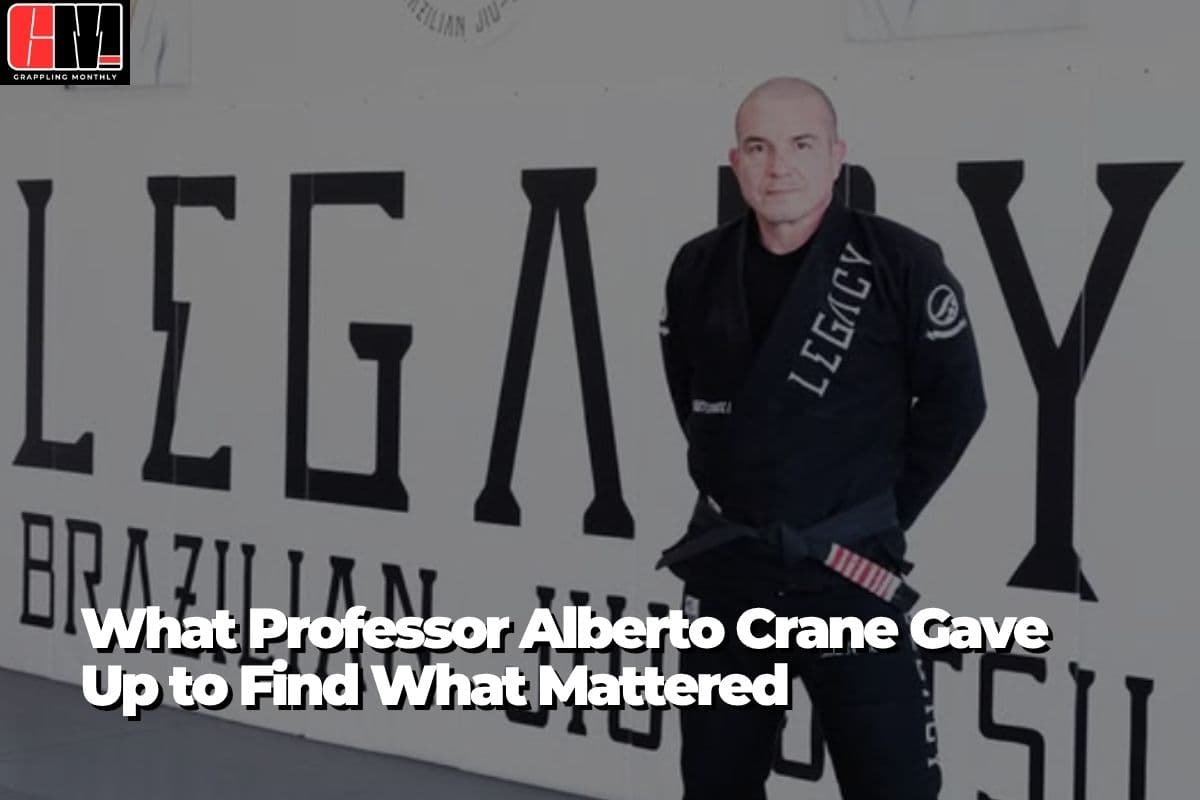
Professor Alberto Crane is a pioneer in the martial arts. Among the first Americans to live and train jiu-jitsu in Brazil, the first American to be awarded the rank of black belt under the Gracie Barra banner, King of the Cage champion, and one of the most respected instructors the art has produced. A name that carries real weight in Southern California jiu-jitsu, which is saying something given how much talent is concentrated here.
When I sat with Professor Crane, we talked for over an hour. The competition records came up. The MMA career came up. The years in Brazil, the move to Los Angeles, the schools across the valley -- all of it came up. But the things I kept coming back to after our chat had less to do with his resume and more to do with two decisions he made when things stopped working the way he planned.
One was a business decision. The other was a fight for his health. And I think they are actually the same story.
Why He Walked Away from Six Schools
At one point, Prof. Alberto Crane was running six locations across Los Angeles. Encino, Pasadena, Hollywood, Woodland Hills, Baldwin Park, West Adams. Good locations. Real infrastructure. The kind of footprint that looks like success from the outside.
He got out of all of them.
"Once I was in front of the computer managing those kinds of things and not on the mat," he told me, "I was like, you know what, I'd rather do something else if this is what I'm going to be doing."
What he came back to was one gym in Burbank, close to his house, close to his students, close to the mat. And the reason he gave for that choice was so simple:
"What's important to me is the relationships. Seeing people get good. Seeing you become better. That's everything to me. That's what motivates me to come in every day."
He had built something real, something with scale and visibility, and he traded it deliberately for something smaller and more personal. Something to think about for anyone in this community who is thinking about what they are building and why. The question is not how many locations you have. The question is whether you are still in the room.
What Happened When His Body Stopped Cooperating
In 2012, a routine MRI before a UFC fight found lesions on Prof. Crane's brain. The diagnosis was multiple sclerosis. His fighting career ended there.
He kept training jiu-jitsu. He kept competing, actually -- almost every month for a stretch -- because as he put it, he did not know how much time he had and he was going to go out on his shield. But underneath that, things were not right. Every joint in his body hurt. He was not sleeping. He was not speaking clearly. He could not reach across his own body to buckle a seatbelt without pain.
"I was okay, I'm okay, I'm okay," he said. "But I wasn't."
What turned it around was not a medical intervention. It was movement. Specifically, a movement system called TACFIT, developed by Scott Sonnon, whom Prof. Crane had first encountered years earlier when Sonnon helped him recover from a neck injury in about a week when conventional wisdom said four to six weeks minimum.
He went to a TACFIT certification in Washington State after his last tournament. Within a weekend, things started shifting. He kept going. He sought out more certifications, traveled to Italy and Spain to train with the best practitioners of the system. And gradually, the things that had gone offline started coming back.
"It just gave me a whole new breath," he said. "And a deeper understanding of how things work."
Prof. Crane wasn't making sweeping claims about what TACFIT can do for anyone else. He was describing his own experience with a system that he came to through desperation and stayed with because it worked. The broader principle he kept returning to is one that most of us know intellectually but struggle to practice: the body is built to move, and when you stop moving it correctly, it will tell you.
What is remarkable to me isn't the recovery itself, although that is most impressive. It was what the experience changed in how he thinks about the practice. TACFIT is now woven into how people train at Legacy BJJ. The cool-down at the end of the noon class, the joint mobility work, the parasympathetic cool-down that takes about five minutes and that he says makes people feel better for the rest of their day. None of that is decoration. It comes directly from what he learned when he had no choice but to pay attention.
"I could still win tournaments," he said. "But I wasn't doing well."
The gap between performance and health isn't always well defined. The difference between what you can still produce on the outside and what is actually happening inside is sometimes staggering. In Prof. Crane's case, he was checking boxes and breaking down at the same time. It took a diagnosis to force the reckoning.
Most of us will not get a diagnosis that clear. Which might be the more dangerous situation.
What Connects These Two Things
On the surface, walking away from six schools and rebuilding your body through a movement practice do not seem like the same story. But I think they are.
Both are about the same underlying question: what is this actually for?
For Prof. Crane, the answer to that question arrived through experience rather than theory. In both cases, it is about being present in something that matters. On the mat with students whose progress you can actually see. In a body that moves the way it is supposed to move. In a community where people know each other, where a 70-year-old named Professor Savage shows up and trains alongside kids who have been on the mat since they were three.
Prof. Crane describes Legacy as an ecosystem. Everything there -- the jiu-jitsu, the Muay Thai, the wrestling, the TACFIT, the recovery and performance services -- is designed to keep people inside a life organized around movement and connection.
I do not know if that vision was fully formed from the beginning or if it revealed itself over time through the choices he made and the ones he walked away from. Probably some of both.
What I do know is that when someone has built something that feels genuinely alive, it is usually worth asking how they got there. Prof. Crane's answer, as best I can tell, is that he kept following the thing that mattered most and let go of everything that got in the way of it.
You can find Professor Alberto Crane at Legacy BJJ in Burbank, California, where he teaches class at noon, six days a week. Legacy BJJ also has additional locations in Glendale, Pasadena, Malibu, West Adams, San Diego, and Yerevan, Armenia.