
Why Jiu-Jitsu Had to Change to Grow
The art grew because it proved itself in public. But it stayed and spread because it changed. It became easier to teach, easier to organize, and easier for more kinds of people to practice.
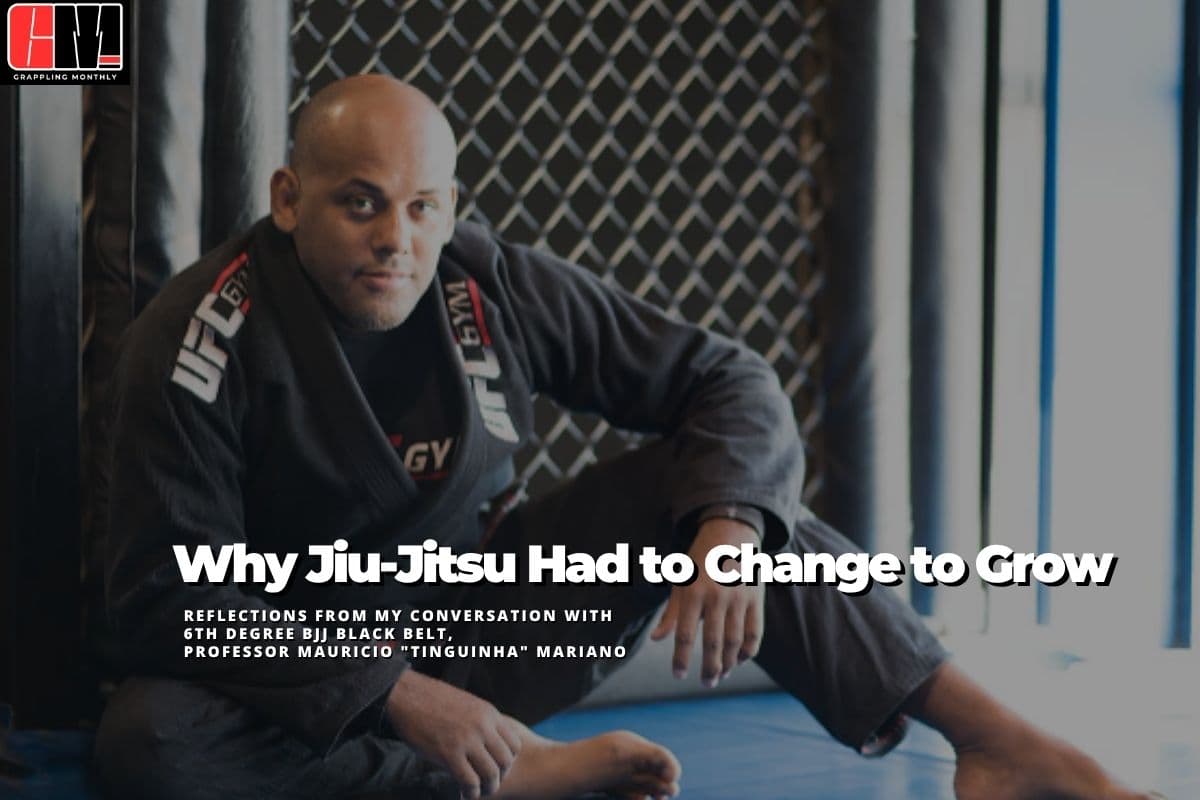
Reflections from my conversation with 6th degree BJJ black belt, Professor Mauricio "Tinguinha" Mariano.
When people talk about the explosive growth of jiu-jitsu worldwide, they usually point to UFC 1 and the Gracie family's choice to put Royce Gracie in a cage with much larger opponents in order to prove the effectiveness of their fighting techniques.
That is definitely part of the story. It is not the whole story.
The art grew because it proved itself in public, yes. But it stayed and spread because it changed. It became easier to teach, easier to organize, and easier for more kinds of people to practice without being broken by the room.
That was one of the more interesting threads in my conversation with Professor Mauricio "Tinguinha" Mariano.
Prof. Tinguinha started training at 11 years of age in Rio in the late 1980s, when jiu-jitsu was still much closer to vale tudo than to the academy model most people know today. He came up in an environment where there were no kids classes, very little formal structure, and no real separation between training for competition and training for a possible challenge fight. It was hard, loose, and serious in a way that a lot of newer students have never experienced.
That history is worth revisiting, not because old-school suffering is automatically better, but because it sheds light on what had to happen for jiu-jitsu to become what it is now.
Before Jiu-Jitsu Became Scalable, It Was Selective
Professor Tinguinha started young. After first training judo, he came into jiu-jitsu through the original Barra da Tijuca scene in Rio, when Gracie Barra was still forming and the culture around training was raw. There weren't many lanes into the art. If you were there, you trained with whoever was in the room. If you were small, you dealt with bigger bodies. If the room was rough, you adapted.
That environment produced tough practitioners. It also filtered people aggressively.
There is a tendency to romanticize that era. Some of that comes from nostalgia. Some of it comes from the appeal of hardship itself. But Prof. Tinguinha was clear enough about what that training looked like. There were no kids classes when he began. Very little of the class structure people now take for granted existed in the same way. It was not built for wide participation. It was built for the people who could survive it.
The old model was effective at producing a certain kind of fighter. It was not designed for scale.
Vale Tudo Shaped the Technical Culture
Early jiu-jitsu was tied to vale tudo logic, and that had a massive impact on what people considered sound and viable techniques.
If open-hand strikes, headbutts, and challenge-fight realities are part of the background, you build your game differently. You think about head control differently. You think about exposure differently. You think about guard differently. Some positions that thrive in sport settings become a lot less attractive when punches and chaos are part of the equation.
Jiu-jitsu in the late 80s and 90s was an art that was solving a different set of problems.
As tournaments became more formalized, sport jiu-jitsu expanded. Different technical space opened up. The rise of no-gi competition, the growth of organized tournaments, and the gradual separation from pure fighting contexts gave new guards and movement systems room to breathe. Prof. Tinguinha spoke about Spider Guard in that light. Not as some isolated invention that appeared out of nowhere, but as something that developed through repetition, adaptation, and problem-solving.
That is often how jiu-jitsu actually evolves. Through people trying to avoid being smashed, finding leverage, repeating what works, and eventually understanding what they have been doing well enough to teach it.
A lot of technique began that way. Survival first. Language later.
The American Contribution Wasn't Only Technical. It Was Structural.
Prof. Tinguinha talks about ways in which the United States helped organize jiu-jitsu.
He described arriving in the U.S. with the ability to teach jiu-jitsu, but not with a developed understanding of the business side. There was no real business plan in the earlier model. You opened a school, put mats down, and hoped people showed up. The class structure was looser. The expectations were looser. Belt progression was more opaque. People trained because the instructor knew the path, not because the path had been clearly laid out for them.
This approach was suddenly met with a culture that seeks out efficiency and responds well to systems designed to optimize learning and growth. Front desks. Intro structures. Kids programs. Beginner classes. Clearer class levels. More explicit roadmaps. More communication around what students are learning and why.
That shift meant jiu-jitsu would become teachable at scale.
This is the part some people still resist. They hear organization and assume softness. They hear curriculum and assume commercialization. But there is nothing inherently shallow about clarity. In a growing art, clarity is infrastructure.
Professor Tinguinha attributes much of why jiu-jitsu now exists in places and at levels of access that would have sounded absurd decades ago to the systematization of teaching and learning in jiu-jitsu. The people who once thought you had to be one of the toughest people in the room to last now run academies filled with children, working adults, women, hobbyists, older beginners, and competitors all under the same roof.
Growth required more than proof. It required translation.
Public Proof Alone Does Not Build a Culture
The famous challenge fights, the luta livre rivalry, and the early vale tudo culture all helped establish jiu-jitsu's legitimacy in a public way. Prof. Tinguinha was there, close enough to see some of that period firsthand. He described the atmosphere around those challenges without trying to sanitize it. The stakes were real. The identities were tribal. The rooms were serious.
But public proof alone does not create a sustainable culture. For the art to spread, it needed to be translated and codified.
It needed to become legible to parents, to become manageable for adults with jobs. It needed to become structured enough that a new student could understand where they were, what they were working on, and why they should come back the following week. It needed to create an environment where a sixty-year-old and a competition blue belt weren't being thrown into the same problem without context.
Prof. Tinguinha explains that in his view, once jiu-jitsu became more organized, more people could learn it.
Good Jiu-Jitsu Still Keeps Both Sides
None of this means the older values disappeared. It does mean that academies are keeping self-defense in view without simulating a street fight in every class. It means teaching sport jiu-jitsu without treating the art as only a points game. It means having structured beginner classes without producing students who never learn how to deal with discomfort. It means making the environment safer and clearer without stripping the practice of its edge.
Each lineage, each school, and each teacher has their own take on the art. Some lean too far in one direction or the other. But successful academies understand that growth comes from organization, while legitimacy stems from the art itself.
Prof. Tinguinha comes from a generation that remembers what jiu-jitsu looked like before the front desk, before the curriculum, before the global seminar circuit, before the assumption that every decent-sized city would one day have a school.
That perspective is a healthy reminder that jiu-jitsu did not become global just because it worked. Plenty of things work and still remain niche. Jiu-jitsu became global because enough people figured out how to preserve the core of the art while making it teachable, survivable, and repeatable for a much larger population.